
Every room tells you how to behave in it.
Not verbally, of course. But through a thousand small instructions encoded in its furniture, its lighting, its layout, and its condition. The high-ceilinged office with the large desk at the far end instructs you to be deferential. The cluttered kitchen with mismatched chairs instructs you to be casual. The empty warehouse with peeling paint instructs you to be alert. The hospital corridor with its harsh fluorescent light instructs you to be quiet, to wait, and to submit to the authority of the building itself.
These instructions are so automatic that we rarely register them. Yet they are always present, shaping behaviour, editing possibility, narrowing or expanding what can happen in a given space. We enter a room and immediately, unconsciously, adjust our posture, our tone, and our expectations. The room has already begun to write the scene before we have spoken a word.
Architecture is not neutral—it choreographs human behaviour. Rooms, corridors, and thresholds silently instruct us on how to act, move, and even feel. Through its geometry and design, a room can encourage intimacy, surveillance, fear, or performance. The same conversation, held in two different rooms, becomes two different conversations entirely.
The Panopticon, designed by Jeremy Bentham in the eighteenth century, was more than just a prison blueprint; it was an idea. Its circular structure with a central watchtower allowed a single guard to observe every prisoner simultaneously, while the prisoners, unable to see the guard, could never know when they were being watched. The uncertainty itself became a tool of control. The architecture did the work of discipline without the guard ever having to act.
Michel Foucault, in Discipline and Punish (1975), seized on this as the perfect metaphor for modern systems of control. The Panopticon was a model for schools, hospitals, factories, and even open-plan offices; spaces where architecture disciplines the body as much as the mind. Space itself becomes a mechanism of power. We behave as though we are being watched, not necessarily because someone is watching, but because the design of the space makes us feel constantly observable.
Every threshold asks us to adjust ourselves
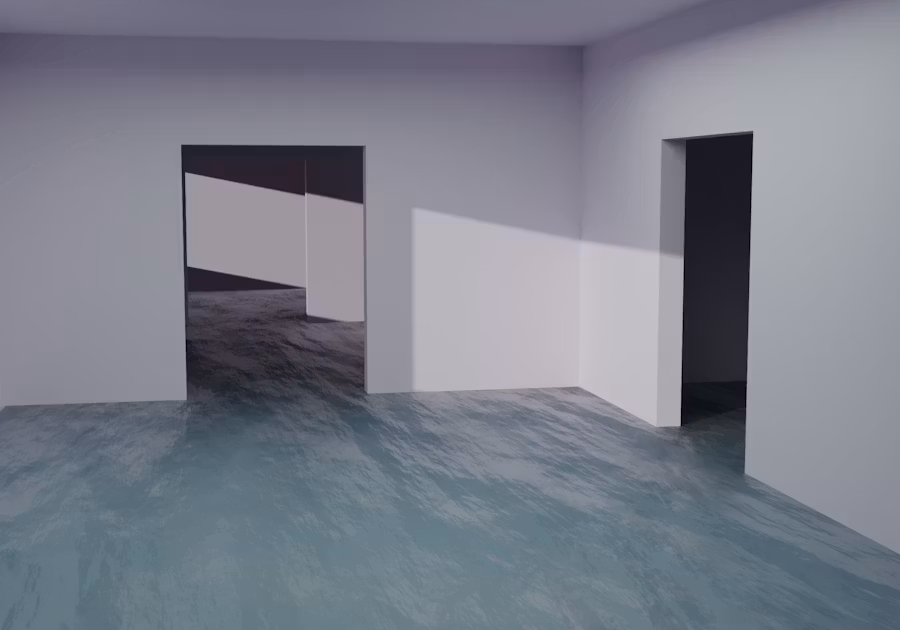
How Rooms Edit Scenes
In Novi Sad Protocol, I became interested in how environments alter narrative logic. A room is not just where a scene happens; it influences what can happen. A scene set in a cramped kitchen cannot proceed like a scene set in a vast auditorium. The space itself imposes constraints—on movement, on visibility, on the number of characters who can credibly occupy it, on what they can do without it feeling forced.
The cramped kitchen suggests intimacy, but also tension. There is nowhere to retreat. Every gesture is visible. The vast auditorium suggests exposure but also the possibility of vanishing into the crowd. The corridor suggests transit, impermanence, and the feeling of being between places. Each space carries its own dramatic logic.
This is obvious in theory but easily forgotten in practice. When a scene is not working, try changing the room. Put the characters in a corridor instead of a lounge. Move them from indoors to outdoors. Elevate them to a rooftop or sink them into a basement. The shift in spatial logic often reveals what the scene was missing: resistance, tension, and the pressure of environment on behaviour.
A scene that feels flat in a neutral room might come alive when the room itself becomes an obstacle. When the characters have to whisper because the walls are thin. When they have to move carefully because the floor is unstable. When they are interrupted by a sound from another room that changes everything.
How buildings decide what happens next
The Foreign Room
For the displaced character, reading a room is complicated. They are often reading two sets of instructions simultaneously: the ones encoded in the new space and the ones they carry from the spaces they left.This creates a particular kind of friction. Consider the character who tries to act casually in a space that demands formality or the character who hesitates in a room where everyone else moves easily, o the one who reads threats in a space that others find comforting. The character who cannot relax because the architecture of the new place contradicts the architecture of memory.
That friction is narrative fuel. It externalises the internal condition of displacement. It makes visible what would otherwise remain interior. A displaced character does not need to announce their estrangement; they reveal it through their relationship to space. The room, in this sense, does not merely contain the self; it can reshape it, compressing individuality under the constant possibility of surveillance. The architecture is active, shaping behaviour through fear, visibility, and the pressure of never being unseen. Foucault’s interpretation of the Panopticon suggests that the most oppressive rooms are those that colonise perception, the walls themselves instruments of watchfulness.
This carries into more mundane places: social housing with no privacy, refugee centres with fluorescent lighting, classrooms designed like boxes. These are spaces where the architecture does not reflect the inhabitants’ needs. It reflects policy. It reflects budget. It reflects the assumption that the people occupying the space are not fully entitled to comfort.
The displaced character is often forced to occupy rooms designed by others and for others. The room does not fit them. They do not fit the room. And the friction between the two tells the story more effectively than any amount of interior monologue.
The invisible architecture of environments
A Practical Approach
When writing a scene, before you decide what your characters say, decide where they are. Then ask yourself:
What is this room instructing my character to do?
Is it telling them to sit still? To be quiet? To perform? To confess? To leave? The room has an intention. Know what it is.
What is my character doing instead?
Are they following the room’s instructions or resisting them? Are they comfortable or uncomfortable? Are they trying to change the room’s meaning, opening a window, turning on a light, rearranging furniture?
What happens when those two forces meet?
This is where the scene lives. The collision between the room’s intention and the character’s counter-intention generates tension, reveals character, and moves the narrative forward.
The answers will lead you to the scene’s centre of gravity. The room is not a container for action; it is a participant in it.
East London as behaviour, not scenery
References
The following works inform the ideas explored in this essay:
Gaston Bachelard, The Poetics of Space
A philosophical exploration of how we experience domestic space. Bachelard argues that rooms, corners, and houses are not neutral containers but repositories of memory and imagination.
Michel Foucault, Discipline and Punish
An analysis of how modern institutions, prisons, schools, hospitals, use architecture and spatial arrangement to produce obedient subjects. Foucault’s reading of the Panopticon remains essential for understanding how space disciplines behaviour.
Juhani Pallasmaa, The Eyes of the Skin
An exploration of how architecture is experienced through the body, not just the eye. Pallasmaa argues that our experience of space is multisensory and deeply psychological.
Yi-Fu Tuan, Space and Place: The Perspective of Experience
A foundational text in human geography that examines how we transform neutral space into meaningful place through experience, memory, and attachment.