
Thresholds are never truly neutral. A doorway appears on the surface to be a simple architectural feature consisting of a frame, a hinge, and a basic passage from one room to another; yet, we rarely cross one entirely unchanged. Every threshold marks a profound transition where inside becomes outside, public space becomes private, and the known world yields to the unknown. Even the most ordinary doorway silently asks us to adjust our posture, behavior, and expectations before we pass through it. Most of the time, this adjustment happens completely without conscious thought because the human body instinctively understands what the logical mind chooses to ignore.
Rooms that issue silent instructions
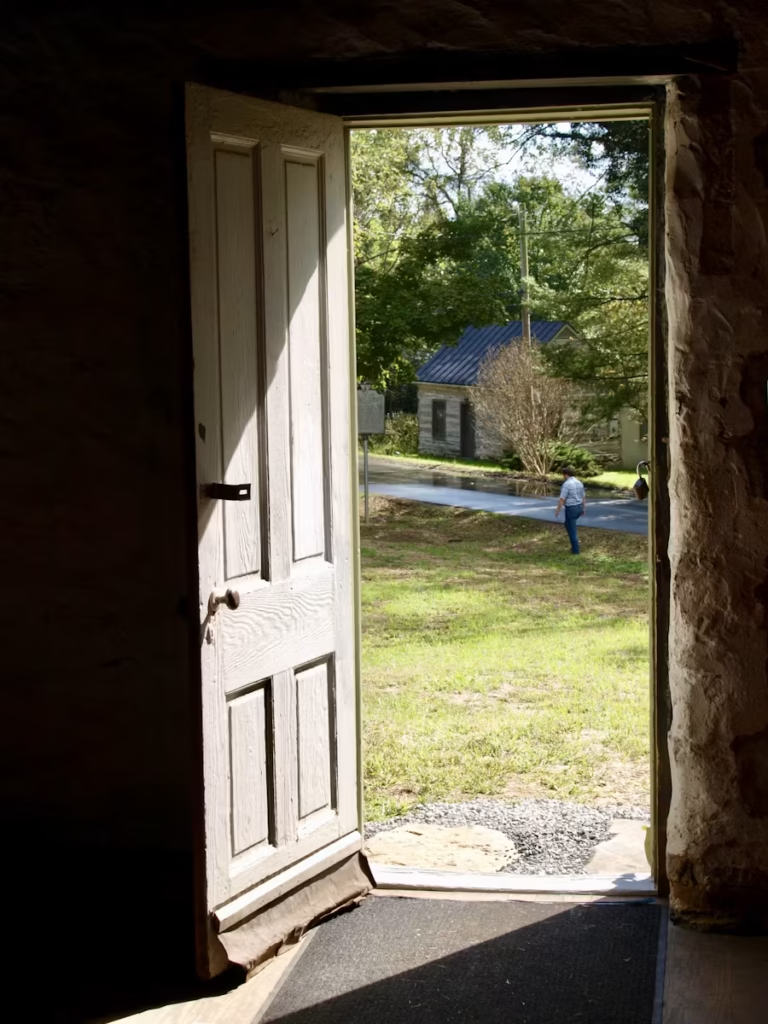
I first began paying close attention to thresholds when I noticed how casually the characters in my early drafts crossed them. They moved through doors, into buildings, and out of rooms, but nothing of consequence seemed to happen to them. The scenes continued as though the crossing carried no weight or narrative penalty. But that is simply not how thresholds operate in reality or in compelling literature. Crossing a threshold is one of the absolute oldest archetypal actions in storytelling: a hero enters the dark forest, a mysterious stranger arrives at the town gate, a detective breaks open a locked room, or a child descends into a hidden cellar. While the physical movement is external, the true transformation is psychological. Something fundamental shifts within the character simply because a boundary has been crossed.
This inherent tension is precisely why thresholds hold such a powerful, permanent place in the horror genre. The most unsettling moments in a narrative rarely occur in the actual presence of danger itself; instead, they manifest immediately before entry. Tension builds as a hand reaches slowly for a rusted handle, a floorboard creaks underfoot, a cellar door stands half open, or a long corridor disappears into total darkness. The reader’s imagination begins its terrifying work long before anything is officially revealed. While a closed door suggests absolute safety and a wide-open door suggests an ongoing intrusion, the most unsettling door is neither of these. It is the door left slightly ajar, not open enough to reveal what lies beyond, but just enough to suggest that an event has already begun in secret.
Corridor as controlled sequencing of perception
Why Doorways Matter
Consider the profound difference between a door you have opened a thousand times and one you have never touched before. The familiar door does not demand your attention, whereas the unfamiliar one instantly slows your progress. Suddenly, you notice environmental details that normally disappear into daily habit, such as the unusual weight of the handle, the distinct acoustics of the room beyond, the sharp quality of light bleeding beneath the frame, and the lingering possibility that whatever waits on the other side may not match your expectations. Familiarity does not actually remove the threshold; it merely conceals it from view.
The underlying transition remains fully active. Acoustics shift, lighting changes, and human behavior alters automatically. A doorway does not simply separate two physical spaces; it effectively separates entirely different versions of reality. This is also the exact mechanism through which successful fiction is constructed. Every chapter break, every scene shift, and every single arrival or departure functions as a major threshold event. Storytelling, at its core, is continuous movement between different states of being. If nothing changes emotionally or psychologically when a character moves through a doorway, then the threshold was never real in the first place; it was merely decorative scenery.
The Architecture of Unease
While writing Novi Sad Protocol, I began noticing that different environments produce entirely different kinds of thresholds. Some spaces intentionally create thresholds of disappearance, utilizing doorways, stairwells, covered passages, and recessed entrances where visibility naturally weakens and people become far harder to track. Crossing these boundaries does not feel overtly dramatic. Instead, it feels incredibly gradual, like slipping out of one atmospheric condition and into another without ever noticing the exact moment the shift occurs.
Other spaces do the complete opposite: they compress the narrative energy. Certain rooms feel as though entering them changes the rules of engagement entirely. The outside world instantly recedes, and the interior environment becomes completely self-contained. You are no longer merely moving through a physical space; you are entering a highly specific system. Under these conditions, the threshold is no longer a simple boundary between two distinct environments; it becomes a fundamental shift in logic.
Consider the control room door in Novi Sad Protocol. It does not function as a passive passage, but as a rigid filter. Those who cross it do not simply enter an office; they enter an intense permission structure. The threshold does not merely describe the setting, it actively determines who is allowed to produce the narrative action within it. This design choices places the work within a rich literary tradition where thresholds function not as architectural features, but as active control systems, a concept visible in Bachelard’s philosophical ambivalence, Uketsu’s spatial unease, and contemporary procedural fiction.
The door left slightly ajar — where silence begins
What I Thought I Was Doing
I once mistakenly treated doorways as mere narrative punctuation, assuming a character simply enters, a character exits, a scene begins, or a scene ends. For a long time, the doorway existed in my mind only to move physical bodies through space. Later, I realized I had misunderstood its structural function entirely. A threshold does not act as a definitive full stop; it functions as a colon. It does not conclude meaning, but suspends it.
It holds certainty in a state of productive tension, keeping the reader suspended between what is currently known and what is about to be discovered. That specific suspended space is precisely where psychological unease lives. It is the sudden hesitation before entering an empty room, the instinctive knock on a door that is already wide open, or the subconscious shift in breathing when moving from bright light into total darkness. These responses feel intensely personal, but they are not; they are entirely architectural.
Buildings instruct us constantly through their proportions, lighting, enclosure, and visibility. Most of those environmental instructions never become conscious thoughts, yet we obey them effortlessly. The true task of writing is not to clinically explain this phenomenon to the reader, but to make them feel it viscerally on the page.
A Thought I Keep Returning To
A doorway is not a rigid line; it functions as a living membrane. While a line merely divides two spaces, a membrane actively filters them, deciding exactly what is permitted to pass through and what must be left behind. No one crosses it completely unchanged. The resulting psychological shift may be incredibly subtle, even imperceptible at first, but it happens nonetheless.
In the end, fiction is made entirely of such shifts. This is precisely why writers like Uketsu in Strange Houses are so phenomenally effective: narrative strangeness is rarely declared openly to the reader. Instead, it emerges organically through physical movement, tracking hallways that feel slightly wrong, corners that seem to hold human attention longer than they should, and spatial transitions that carry an unexplained psychological weight.
The exact same logic appears throughout Gaston Bachelard’s philosophical thinking, which asserts that the door is always simultaneously an invitation and a refusal. Every threshold asks a series of silent, critical questions: Do you enter? Do you remain? Do you proceed, or do you retreat? The character’s ultimate answer is what becomes the narrative.
How to Write a Threshold
A threshold is never a static object; it is an active event. Therefore, it should not be dryly described to the reader; it must be enacted through prose. What matters most is not the physical aesthetic of the door itself, but what specific traits change during the crossing, such as a character’s posture, attention, expectation, or breath. If nothing shifts within the character, then nothing has truly been crossed.
Furthermore, repetition is what deepens the significance of these spaces. The exact same doorway crossed twice by a character is never the same space twice. The most effective thresholds in fiction do not resolve cleanly after a character passes through; instead, they remain partially open in the reader’s mind, casting a long shadow over the rest of the narrative.
Closing
A threshold is never fully understood or intellectualized; it can only be crossed again and again. Each individual crossing alters something within the character that cannot be fully recovered. This alteration does not happen dramatically or visibly, but structurally. The doorway matters immensely because the person who enters a room is never exactly the same as the person who leaves it. In that precise difference, barely perceptible yet never fully recoverable, the true narrative takes shape.