
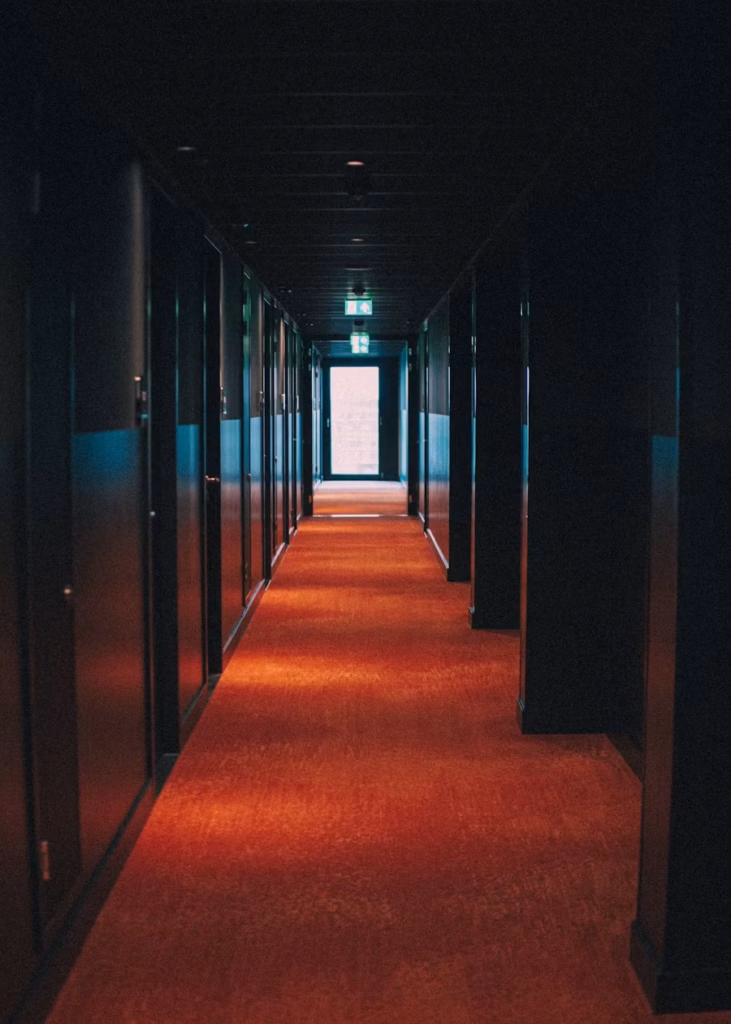
A corridor. Fiction does not place characters in rooms simply to describe the space. It places them there because the space shapes what they can do next.
A corridor that feels longer than it should. A stairwell where sound arrives slightly out of phase with movement. A doorway that interrupts action before intention fully forms. Buildings enter fiction quietly, but they rarely remain neutral. They organise perception. They delay certainty. They determine what can happen next.
The question is not what buildings contain. The question is what they produce.
The Architecture of Stored Pressure
A building in fiction is never neutral. It is compressed instruction. Space folded into behaviour until movement becomes its most accurate expression.
A corridor is not a passage. It is controlled sequencing of perception. A stairwell is not simply a vertical connection. It turns interruption into something physical. A doorway is not merely a transition. It is a threshold that regulates visibility before entry occurs. A room is not a container. It creates limits on what can be known inside it.
The strongest works of fiction understand this instinctively.
In Secret Beyond the Door, the house does not simply reflect psychology. It produces it. In High-Rise, vertical architecture becomes a system that reorganises behaviour under pressure.
Buildings do not describe action. They condition it.
And that is why certain spaces stay in memory long after the plot fades. They keep working in the mind, shaping how tension builds, how scenes unfold, and how meaning emerges without us noticing.
How rooms produce behaviour through invisible control
The Companion Space — What Moves When Stability Breaks
Some spaces in fiction travel with characters. They are not just settings. They become structures that shape behaviour when everything else begins to fail.
In Novi Sad Protocol, the spaces surrounding Amir Kamara’s escape do more than provide locations for the action. They become systems of pressure. Poplar’s recessed thresholds narrow what can be seen, forcing characters into heightened awareness and careful observation. Whitechapel’s sealed interiors turn privacy into tension, creating spaces where information, silence, and trust become difficult to control. The stadium’s transformation from a place of public movement into a contained enclosure reveals how architecture can shift from freedom into control.
Each space changes the choices available to the characters. It limits what they can perceive, what they can say, and how they can move.
When stability disappears, the building becomes one of the few things left that still holds the rules.
The Architecture of Displacement
Architecture does not sit in the background of narrative. It actively shapes it.
A corridor changes how strangers move toward each other. Dmitri walks through it without noticing when his pace adjusts. It is not choice. It is calibration. The space has already set the rhythm.
He does not think about the building.
He simply moves through the possibilities the building creates.
This is where architecture stops being a setting and becomes procedure; a system that stores behaviour in geometry.
Elsewhere, stairwells interrupt thought mid-flow. Doorways shift the balance of a conversation before it settles. Rooms redirect attention without announcing it. These are not symbolic effects. They are physical ones.
The doorway that regulates visibility before entry
The Inherited Space — When Architecture Arrives Before Meaning
Some spaces arrive carrying a history before the characters understand what it means.
A corridor that feels strangely familiar on first entry. A room whose proportions suggest repetition without origin. A building whose logic seems older than the people who inhabit it.
Inherited spaces are never neutral. They carry traces of the past before interpretation begins.
In The Namesake and Beloved, environments hold generational weight that exceeds what characters can fully understand. Architecture does not belong to the present moment. It extends beyond it.
The inherited space creates a tension between what you believe you’re entering and what was already there.
The Space That Fails to Hold
Not all architecture remains stable.
Some spaces collapse when you pay attention to them too closely. Some lose coherence under pressure. Some stop functioning as environments that can carry narrative.
A corridor that no longer guides movement. A room that no longer holds focus. A threshold that no longer produces transition.
When space breaks, it doesn’t disappear.
It leaves a gap that still shapes everything around it.
What remains is not the building itself.
It is what the building no longer holds in place.
Craft Toolkit — How to Write Architecture That Matters
Place space under pressure.
Characters should unconsciously adjust to it before they understand why.
Let spaces repeat with variation.
Each return should subtly change rhythm, attention, or constraint.
Use space as instruction rather than description.
Movement often says what dialogue cannot.
Make spatial failure meaningful.
If a room can collapse without affecting the story, it was never doing any work.
The Architecture as Unspoken Narrative System
Architecture doesn’t sit next to narrative. It shapes where narrative becomes possible.
Language tries to clarify. Space complicates, delays, and distributes meaning across movement.
That is why fiction keeps returning to corridors, thresholds, stairwells, and enclosed rooms at moments of instability. They hold contradiction without forcing resolution.
Language demands clarity.
Architecture works through positioning.
That difference is where its power sits.
Popular, Whitechapel, and the stadium as constraint systems
Closing — What the Building Leaves Behind
Buildings in fiction are not what characters occupy. They are what characters cannot fully leave.
A corridor that keeps shaping memory. A stairwell that remains as rhythm in thought. A room that continues as constraint long after it is exited.
These are not settings.
They are residual systems.
They are pressure held in space.
They are behaviour stored in geometry.
When movement, intention, and certainty fall away, what remains is not the place itself but the position it created.
That position continues to shape how characters see, act, and remember.
In fiction, the effects of a space often outlast the space itself.