
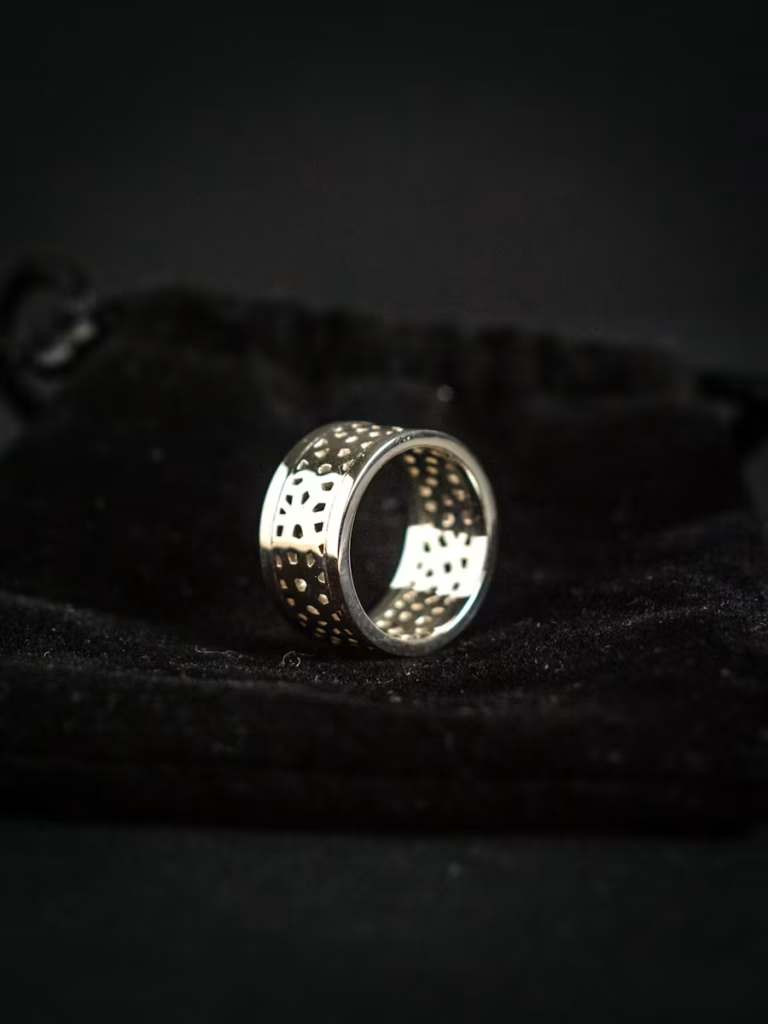
A silver ring turned between fingers in the dark. A photograph is folded and unfolded until the edges soften. A compass carried across borders long after its bearings can no longer be trusted. Objects enter fiction quietly, but they rarely remain quiet. They absorb pressure. They accumulate memory. They carry what language cannot hold.
The question is not what objects mean.
The question is what they continue to carry after words have failed.
Dmitri turns the ring — ritual as substitute for speech
The Object as Stored Pressure
An object in fiction usually means more than it first appears to. Experience stored in a physical form that words can no longer fully explain.
A ring is not just jewelry. It may carry years of love, loss, or promise. A key is not only metal. It can represent access, separation, or something that has been hidden away. A notebook is not simply paper. It holds thoughts, decisions, and consequences that shape a character’s life. A photograph is not just an image. It preserves a moment that continues to affect the present.
The greatest novels understand this instinctively.
In the remains of the day, objects often reveal more than conversation. In atonement, a broken vase becomes a visible sign that something deeper has been damaged. In the children’s book, inherited possessions expose histories that refuse to settle.
Objects do not explain the past.
They continue it.
This is why readers remember them long after dialogue fades. They remain in the imagination carrying the residue of everything attached to them.
The Companion Object — What Travels When Identity Fractures
Some objects move through a narrative alongside a character. They are not tools. They are anchors.
A watch survives when certainty does not. A photograph survives when memory becomes unreliable. A ring survives when the person who gave it is gone.
These objects provide continuity in stories shaped by displacement, grief, migration, war, or transformation. They become fixed points in worlds that no longer hold still.
In The English Patient, Herodotus becomes a portable homeland layered with annotation and loss. In The Sun Also Rises, ordinary objects acquire emotional weight because they persist while relationships deteriorate. In The Time Traveler’s Wife, material possessions become evidence of presence across impossible distances.
Contemporary British and European fiction increasingly relies on this logic. In Slow Horses, files, records, and physical traces often carry more truth than the people handling them. In the Woods, material remnants anchor identities that language cannot stabilise.
The object becomes continuity when continuity itself is under threat.
Objects that continue the past rather than explain it
The Object as Displacement Record
Across Novi Sad Protocol, objects do more than decorate the story. They carry the weight of what characters cannot say.
Consider Ana’s silver ring.
Dmitri turns it between his fingers in the dark.
The metal has warmed to his skin after years of handling. He no longer remembers when the gesture became habit. It is not sentiment. It is not nostalgia. It is something closer to ritual.
The ring belonged to Ana before the fracture. Before departures became permanent. Before choices hardened into consequences.
He turns it once.
Then again.
The repetition produces no answer. It produces a pause.
And inside that pause, the ring holds everything language can no longer carry: absence, loyalty, regret, uncertainty, responsibility.
He does not put it away.
He turns it again.
The gesture is not memory.
It is a method of continuing.
This is where objects become more than symbols. Dmitri does not think about the ring. He thinks through it. The object becomes a substitute for speech, a physical structure that allows him to navigate pressures too complex for direct articulation.
Elsewhere in the novel, a jade chess rook, a Nomoli figurine, and a compass necklace perform similar functions. They pass between characters, survive borders, outlive explanations. They are not clues waiting to be decoded. They hold emotions, memories, and responsibilities that cannot easily be expressed.
This places Novi Sad Protocol within a broader tradition visible in Ishiguro’s restraint, McEwan’s moral ruptures, Herron’s operational silences, and French’s investigative absences. In these works, objects do not merely represent interior life.
They take over when interior life can no longer be expressed directly.
Objects that cross borders long after explanations have expired
The Inherited Object — When Meaning Arrives Without Consent
Some objects arrive already carrying a story.
A ring that fits too precisely, as if it was always meant for a hand that does not yet exist. A photograph without explanation. A locked box whose contents matter less than its persistence.
Inherited objects are not gifts.
They are obligations.
In The Namesake, possessions become unstable carriers of identity across generations. In Brooklyn, ordinary belongings carry the pressure of migration and return. In Beloved, material traces become inseparable from memory itself, binding the living to histories they did not choose.
The inherited object forces a confrontation between who a character believes they are and what history has already placed in their hands.
It transforms possession into responsibility.
The Object That Fails to Survive
Not every object endures.
Some disappear. Some are abandoned. Some break.
A lost ring. A shattered figurine. A compass that no longer points where it once promised.
Their destruction is not narrative housekeeping.
It is narrative consequence.
In Atonement, the broken vase cannot simply be repaired because repair would erase meaning. In The Goldfinch, the painting survives physically yet functions as a wound carried through the entire narrative.
When objects break, they do not leave the story.
They change its structure.
What remains is not the object itself but the absence it creates.
And absence can weigh as heavily as presence.
Craft Toolkit — How to Write Objects That Matter
Place the object under pressure.
Objects become meaningful when characters reach for them at moments of uncertainty, conflict, or decision.
Let the object recur with change.
Each appearance should reveal wear, damage, loss, distance, or transformed significance.
Use objects as substituted speech.
A gift, an exchange, or a returned possession can communicate what dialogue cannot.
Make destruction consequential.
If an object breaks and nothing changes, the object never truly mattered.
The Object as the Unspoken Structure of Fiction
Objects do not sit beside language.
They activate where language reaches its limits.
A spoken explanation often reduces complexity. An object preserves complexity because it remains partially unresolved. It can carry contradiction without collapsing under it.
This is why fiction repeatedly returns to objects at moments of ethical instability, emotional fracture, and narrative transition.
A ring can hold grief, loyalty, memory, guilt, and love simultaneously without choosing between them.
Language demands clarity.
Objects tolerate ambiguity.
That tolerance is one of their greatest narrative strengths.
Popular, objects, and the residue of East London
Closing — What Remains in the Hand
Objects in fiction are not what characters own.
They are what characters cannot release.
A silver ring turned endlessly between fingers. A photograph carried across continents. A compass kept long after it ceases to guide.
These are not symbols waiting to be interpreted.
They are pressure held in material form.
They are memory condensed into weight.
And when speech, explanation, and certainty finally fall away, what remains is not language.
It is what the hand still carries.
It is weight.
And weight is how fiction remembers what it cannot say.