
Every time you recall a place, you are not retrieving a fixed image but assembling one from fragments, shaped by subsequent experiences, emotions, and the distance of time. The place you remember is not the place that existed. It is the place that survived.
This is not a flaw. It is a feature, and it is one of fiction’s most powerful tools.
In Emma Healey’s Elizabeth Is Missing, memory becomes unstable in a way that feels almost architectural. The present fractures, while the past arrives with unnerving clarity. The reader moves between two registers of truth: what is happening and what memory is reconstructing. That tension, between erosion and reconstruction, is where the novel lives.
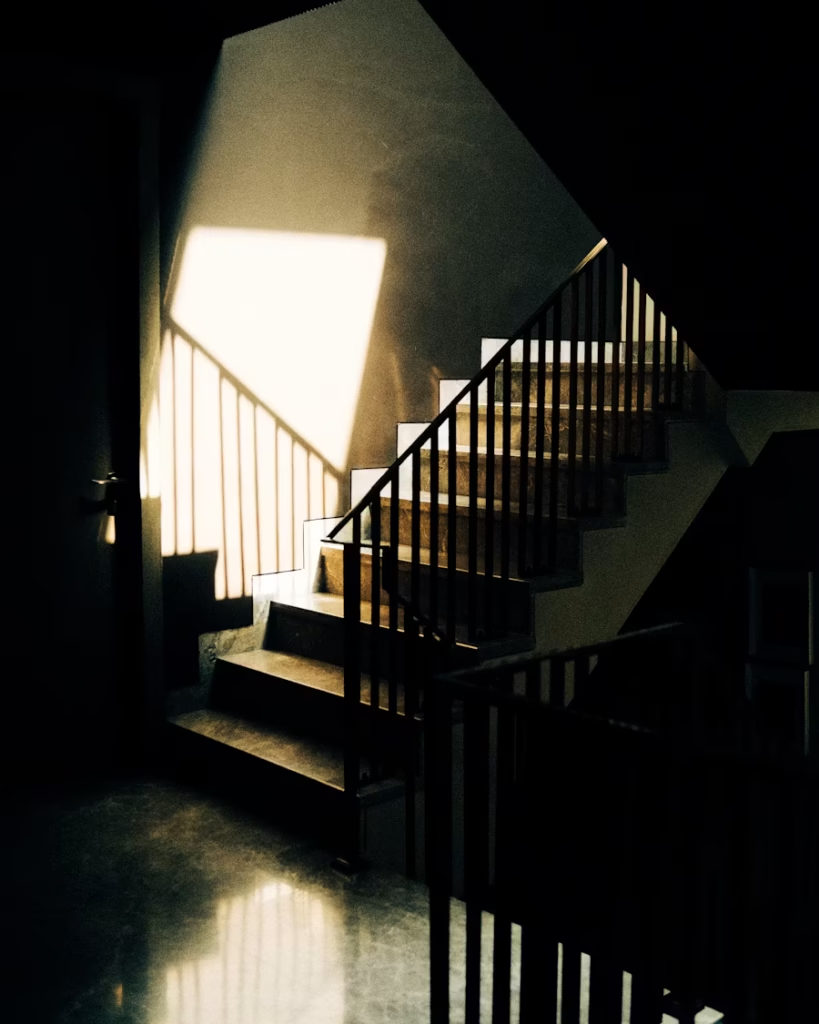
The staircase you remember is never the staircase you climb.
Exile as reconstructive, not linear, memory
The Place That Never Fully Matches Itself
When I write about Poplar in Novi Sad Protocol, I am not writing about a fixed geography. I am writing about a constructed version of Poplar, assembled from maps, photographs, planning documents, and fragments of street-level experience.
The same condition appears in the novel’s bridge sequence. Hassan Farouk returns to a structure memory has enlarged into something more stable than reality ever allowed it to be. He remembers it as monumental, a fixed point in a world that had become unsteady. In the present, nothing has changed. The concrete is the same. The steel is the same. But the bridge is smaller now. Less final. Less capable of holding the weight he had assigned it.
The mismatch is not in the structure.
It is in the observer.
That fracture, between the bridge that was carried and the bridge that remains, is not atmospheric detail. It is the narrative engine of the scene. Much of the story now lies in the gap between those two versions of the place.
This is what places Novi Sad Protocol alongside a broader tradition of fiction that treats place as unstable ground, from Sebald’s architecture marked by traces of the past to Healey’s fractured present. In each, memory does not explain the past. It reconstructs it in the present tense, and the gap between versions becomes the story’s real subject.
What Returns Does Not Match What Remains
Consider what happens when a character returns to a childhood home.
The house has not changed. The character has.
The hallway feels shorter. The garden feels smaller. Rooms that once contained entire worlds now appear reduced to proportion. That shrinkage is not deception. It is time made spatial.
Something more important is happening beneath the description: perception is no longer aligned with memory. The character is not misremembering the house. They are encountering the distance between who they were and who they have become.
That discord becomes narrative structure. It reveals transformation without stating it. It turns geography into evidence of change.
Writing about Poplar as a constructed version, not fixed geography
The Architecture of Recollection
W.G. Sebald understood this better than almost anyone.
In Austerlitz, the search for the past is not a search for facts but for texture. Railway stations, fortresses, corridors, and archives become receptacles for memory that refuses to settle into chronology. The past is not recovered. It is approached indirectly, through spaces that still carry its pressure.
Sebald’s photographs intensify this effect. They do not function as proof. They function as residue. They do not confirm history. They confirm sensation.
Memory, at its most powerful, stops behaving like retrieval and starts behaving like atmosphere. It is no longer about what happened. It is about what lingers. That shift, from documentation to presence, is the foundation of memory in fiction.
The exile remembers not as narrative but as sensation: humidity, light angles, echoes, the weight of air in enclosed rooms. These are not decorative details. They are triggers of return.
Writing the Gap
To write memory well, accuracy is not the goal. Alignment is.
The most important question is not what a place looked like, but how memory distorts, reshapes, or resists it.
The gap between remembered place and encountered place is not a flaw in perception. It is the site where fiction forms.
A useful question: what does your character consistently misremember about the same place?
That error is not incidental. It is structural.
Objects that outlive the memory attached to them
How Memory Produces Place
Memory does not simply reside within a place. It reconstructs it each time it is summoned.
This is why the most effective settings in fiction are rarely the most detailed. They are the most unstable. The reader completes them through their own memories and experiences, and in doing so, participates in their reconstruction.
The place becomes collaborative.
The writer provides fragments. The reader supplies continuity.
In that exchange, a third version of the place emerges; one that belongs fully to neither.
How to Write Memory as Place
Do not describe the place as it was. Describe how it arrives in the present tense of perception.
Look for mismatches rather than accuracy. The gap between versions is the scene.
Return characters to places that no longer agree with them.
Let memory interrupt perception rather than explain it.
Trust incompleteness. What is missing often carries more weight than what is present.
The world seen twice — comparatively
What the Gap Produces
The gap between remembered place and real place is not a failure of recollection. It is where meaning forms.
It turns geography into time.
It turns space into evidence.
It turns a return into a transformation.
The past does not remain fixed. It shifts each time it is approached, reshaped by the person doing the remembering. The writer’s task is not to correct this distortion, but to use it.
Closing
Memory is not a photograph. It is a reconstruction under pressure.
The places we remember are not the places we inhabited. They are the places that have been carried forward, altered by time, reshaped by self, and rewritten every time they are recalled.
That is not a limitation of memory.
It is its narrative function.
Once that becomes visible, memory is never just memory again.
It becomes the space where fiction begins, not because it records what happened, but because it reconstructs what continues to matter. The remembered doorway is never quite the doorway that remains.