
what it means to be foreign in your own story
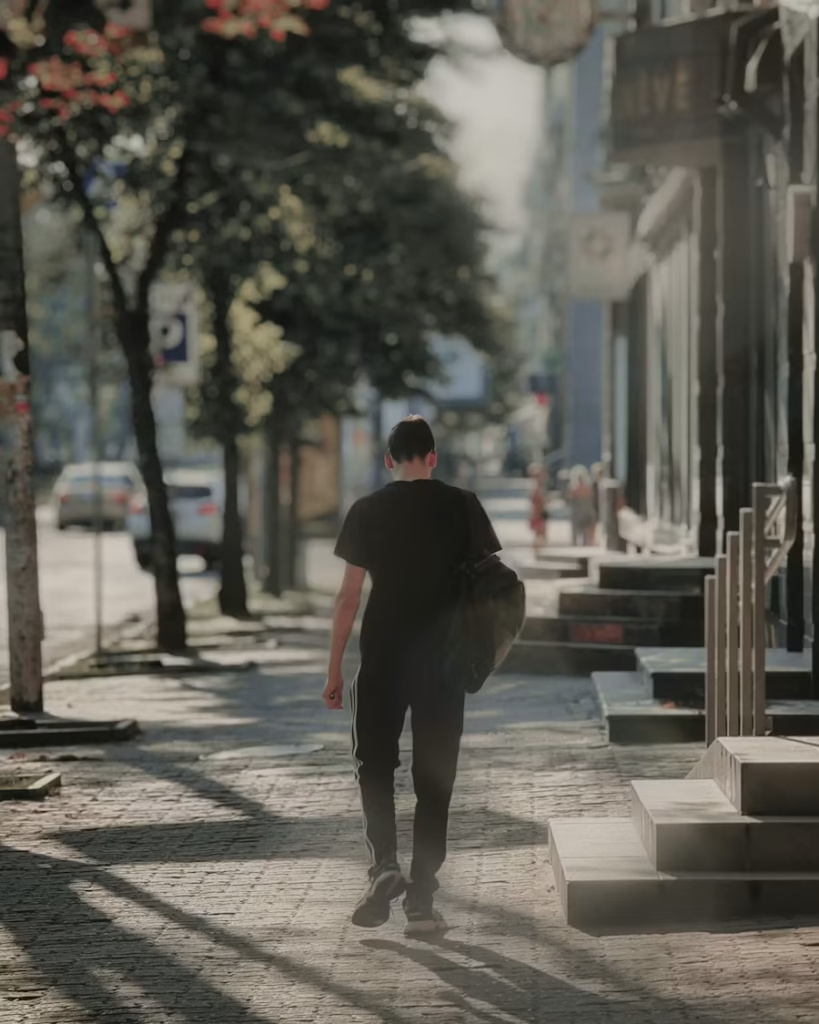
There comes a specific moment in the experience of displacement when you realize you belong nowhere fully: you are no longer entirely whole in the country you left, yet you remain slightly disconnected from the one you now inhabit. This realization is seldom a dramatic, sudden revelation. It arrives quietly as a slow accumulation of small instances: the predictable way people ask where you are “really” from, the subtle pause as you catch yourself translating thoughts before speaking, and the way the concept of “home” begins to point in two completely opposing directions. One direction leads backward to a culture that has moved on without you, while the other points forward to a society that has not yet fully learned your name.
This state of being extends far beyond mere geography. For many, foreignness matures into a permanent way of seeing. You begin to read social spaces differently, noticing deep-seated cultural assumptions that others do not register, such as the effortless ease with which the un-displaced move through life, their sense of belonging so automatic it never requires validation. Eventually, you understand that identity is an active, ongoing compromise. This is the precise territory I find myself writing within: treating displacement not as an abstract subject to be explained, but as a living condition to be fully inhabited on the page.
Crime fiction and literary fiction have long been drawn to outsiders. Traditionally, the outsider was cast as a detective whose emotional distance sharpened their analytical perception, or as a mysterious foreign presence bringing disruption and suspicion to a community. However, that narrative frame has begun to shift significantly. Contemporary writing is far less interested in what outsiders do to drive a plot, focusing instead on what it actually feels like to exist as one.
How place pressures character before a word is spoken
The Gift of Fresh Eyes
Jinwoo Park’s Oxford Soju Club emerges directly from this creative shift. Drawing on his own personal movements between Korea, Canada, the United States, and the United Kingdom, Park describes the exhausting years spent adjusting his personality to fit his immediate context. This process involves softening, sharpening, and constantly recalibrating one’s speech and cultural references, trying on different versions of the self to discover which iteration will be accepted in any given room. What he describes is not adaptability celebrated as a triumph, but adaptability experienced as sheer exhaustion: code-switching utilized as a tool for survival rather than a social skill.
What lingers longest is not the physical act of adjustment, but the psychological residue left in its wake. Even when social acceptance finally arrives, it frequently comes with unspoken conditions attached. Belonging is provisionally granted but never fully released; you are welcomed into a space, but never without a quiet awareness of your inherent difference. Hospitality certainly exists, but it is almost always accompanied by a subtle reminder that you are still an outsider who has just arrived.
This reality produces a permanent double vision, forcing you to see yourself from the inside while simultaneously tracking how you are being read from the outside. Holding these two conflicting perspectives at once is not a sign of psychological instability; it is the fundamental grammar of the displaced experience.
Isabel J. Kim’s Sublimation approaches this condition through a more speculative register. In her narrative, immigrants literally split into parallel selves: one who leaves and one who remains behind. Both distinct lives proceed simultaneously, and neither cancels out the relevance of the other. The true question the work poses is not which life is authentic, but how both realities can exist at the exact same time.
The heightened perceptual clarity of displacement
The World Seen Twice
This narrative structure gives physical form to a haunting question that rarely finds its way into daily language: what specific version of my life did I leave behind? The unlived life does not simply vanish into nothingness. It continues to unfold elsewhere in vivid, counterfactual detail, carried by a version of you who stayed, made different choices, and never crossed the border. That phantom figure is not entirely you, yet it is not fully a stranger either; it remains a shadow walking beside every real-world decision you actually made.
There is no neat resolution to this internal doubling, only the reality of distance. Distance is often the only measurable element in an otherwise unquantifiable transition. You can easily count physical miles, but you cannot measure the strange compression of time that migration inflicts on the mind. You can physically return to a geographic place, but you can never return to the precise version of yourself that originally left it. The geography remains completely legible, but the self does not.
Modern mobility easily collapses physical space, but it fails to synchronize time. A person can cross an entire ocean in a matter of hours, yet a true sense of belonging still takes years to develop, if it manages to arrive at all. While logistics and transportation run fast, belonging moves deeply slow; the former answers to global infrastructure, while the latter answers strictly to memory.
This exact cultural gap is what fiction is uniquely equipped to explore. The novel can place conflicting timelines directly side by side without forcing a neat resolution between them: balancing here and there, then and now, presence and absence. These elements do not function as mere cinematic flashbacks, but as a complex state of coexistence. This internal friction is not a structural problem for the writer to fix; it is the authentic structure of the human experience itself.
The Cost of Seeing
What makes these contemporary stories endure is their refusal to offer clean, comforting resolutions. The displaced character never fully assimilates, nor do they ever fully return to who they were. Instead, they exist in a permanent intermediate state characterized by accumulation and intricate layering rather than total synthesis. They become a complex manuscript of multiple selves where earlier identities are never fully erased. These past versions remain partially legible beneath the surface, heavily shaping how the present reality is perceived. This outcome is not a personal failure of integration; it is a profound literary form, representing a life that has naturally expanded far beyond the rigid cultural architecture built to contain it.
Within these narratives, place is never a passive element. It acts, it exerts pressure, and it actively edits human behavior, revealing traits that would otherwise remain hidden. The city is never a mere backdrop; it functions as an active force.
Consider the way a newcomer automatically adjusts their physical posture before entering certain rooms, unconsciously softening or sharpening their accent, and quickly sensing which spaces are genuinely hospitable versus those that are merely tolerant. These shifts are not calculated, conscious decisions; they are instinctive somatic responses to spatial pressure. The environment does not wait for a character to arrive; it begins actively reshaping them long before they ever cross the threshold.
Writing Through the Immigrant’s Gaze
To exist as a foreigner in your own story is to carry the weight of multiple identities at once. Under this pressure, identity stops behaving like a fixed destination and begins behaving like constant motion: fluid, constantly negotiated, and continuously revised.
Admittedly, not all migration experiences feel like a violent fracture. Some individuals integrate smoothly into new societies, building clear continuity across borders without experiencing a visible psychological rupture. Yet, even in those seamless transitions, there is almost always a quiet, lingering awareness that an entirely different. version of life exists elsewhere, unchosen but certainly not extinguished. You do not have to be actively haunted by that alternative path for it to make its presence felt in your quietest moments.
Jinwoo Park has spoken thoughtfully about reaching a personal turning point where he no longer felt the burning need to prove his belonging in either direction. This milestone was not a neat resolution of his identity crisis, but rather a gradual loosening: a peaceful release of the exhausting obligation to be fully legible to every room he entered.
What Park describes as lived, daily exhaustion is rendered structural in Isabel J. Kim’s Sublimation, where parallel selves cease to be a literary metaphor and become a literal condition. Together, these writers reveal that displacement is an enduring cultural pattern rather than a bizarre exception, representing a recurring form across countless individual lives.
Modern movement collapses space but not time
What the Newcomer Sees
This shared thematic focus places Novi Sad Protocol within the exact same field of psychological inquiry. Its characters do not simply travel through physical geography; they navigate deeply competing systems of loyalty and belonging. Amir carries the heavy, unyielding memory of Azraq directly into the streets of London, leaving him permanently unable to fully arrive in either world. Hassan exists in a tense limbo between the professional engineer he used to be and the covert operative he has been forced to become. Even Dmitri experiences a profound internal displacement, completely unable to journey back to the self that existed before profound grief reorganized his entire reality. None of these individuals manage to resolve the gap between their worlds; instead, they simply learn how to continue living inside it.
This approach rejects the tired narrative arc of triumphantly overcoming displacement, choosing instead to depict the reality of learning to inhabit it without collapsing under the weight. This perspective firmly positions the modern novel alongside a broader, vital body of contemporary literature. From Park’s lived code-switching to Kim’s structural doubling, foreignness is no longer treated as a temporary plot disruption, but as a permanent human condition. In each of these vital works, belonging is never magically restored: it is completely rewritten from scratch.
A Thought I Keep Returning To
Perhaps this reframing is precisely what fiction offers at its absolute best: not easy, prepackaged answers, but a durable cognitive structure for carrying unresolved, heavy questions without breaking under their immense pressure. The contemporary novel does not set out to solve the puzzle of displacement; it merely holds the condition still long enough for its true dimensions to become fully visible to the reader.
Most human lives, when examined closely, do not resemble clean, straight lines. They resemble dense, rich accumulations of disparate places, languages, departures, returns, and unexpected interruptions. Identity is rarely a simple, triumphant movement from a fixed origin to a final arrival. It is a deeply layered geography held entirely inside a single, complex human consciousness.
Identity as motion, not destination
Closing
Ultimately, being a foreigner in your own story is not an inherent defect or a clean fracture in the self. It is simply what happens when the sheer scale of a human life far exceeds the narrow social architecture we construct to contain it. To live dynamically between two worlds is to develop a highly specialized, double attention where the present moment never arrives entirely alone: it always arrives alongside its own poignant absence. You are granted the rare ability to see exactly what is there and what is missing in the very same glance. This experience is not one of pure loss; it is an extraordinary form of vision completely unavailable to those who have never been forced to translate themselves into existence.